
We Don’t Predict. We Prepare.
The four words at the bottom of every roadmap, and why they might be the only honest sentence in financial media.

Every roadmap I publish ends with the same four words. We don’t predict. We prepare.
A new reader asked me recently if that was just a slogan, the trading newsletter equivalent of a motivational poster with a mountain on it. Fair question. The internet is full of finance people with taglines, and most of those taglines translate roughly to “trust me, I am very smart.”
So this piece is the honest answer. It is the entire philosophy behind this publication, explained once, in full, for free. If it resonates, you will understand every map I publish from here on. If it does not, you will at least know exactly what you are not subscribing to, which is its own kind of service.
The prediction industry has a small problem
Here is a fun exercise. Go find any financial TV segment from a random Tuesday two years ago. Watch confident people in nice suits explain, with total conviction, what the market was about to do. Then check what it actually did.
The results are humbling, and not for you.
This is not because the people in the suits are stupid. Many of them are brilliant. It is because they have been assigned an impossible job. The market is an auction with millions of participants, each with different information, different time horizons, different pain thresholds, and different bosses yelling at them. Predicting its exact path is like predicting the exact shape of a crowd leaving a stadium. You can know a lot about crowds and still not know which door Dave uses.
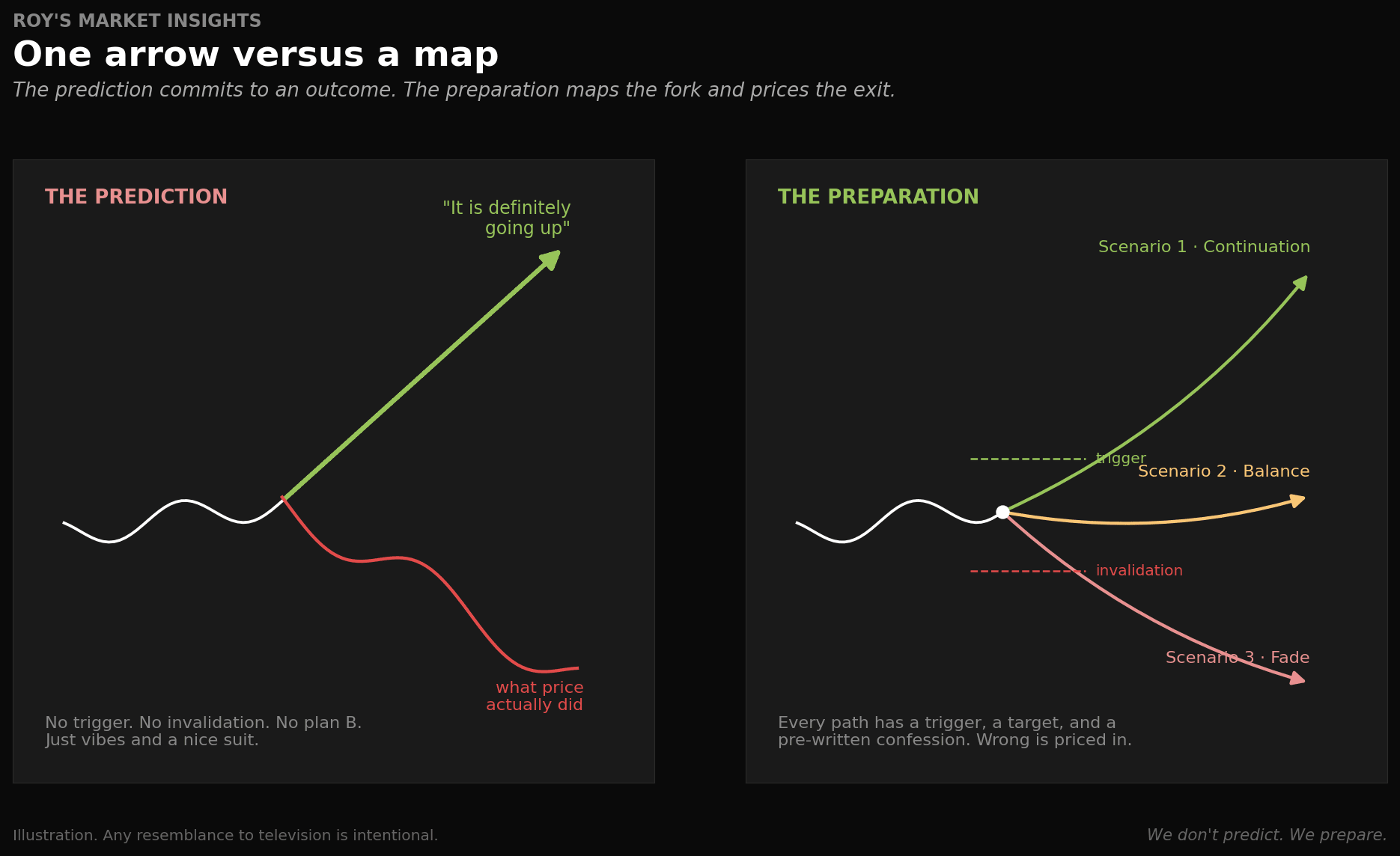
But prediction is what sells. “The S&P will hit 8,000 by December” is a headline. “Here are three ways tomorrow could unfold and the exact price where each one is proven wrong” is homework. One of these gets you booked on television. The other one makes you money. They are rarely the same sentence.
What I do instead
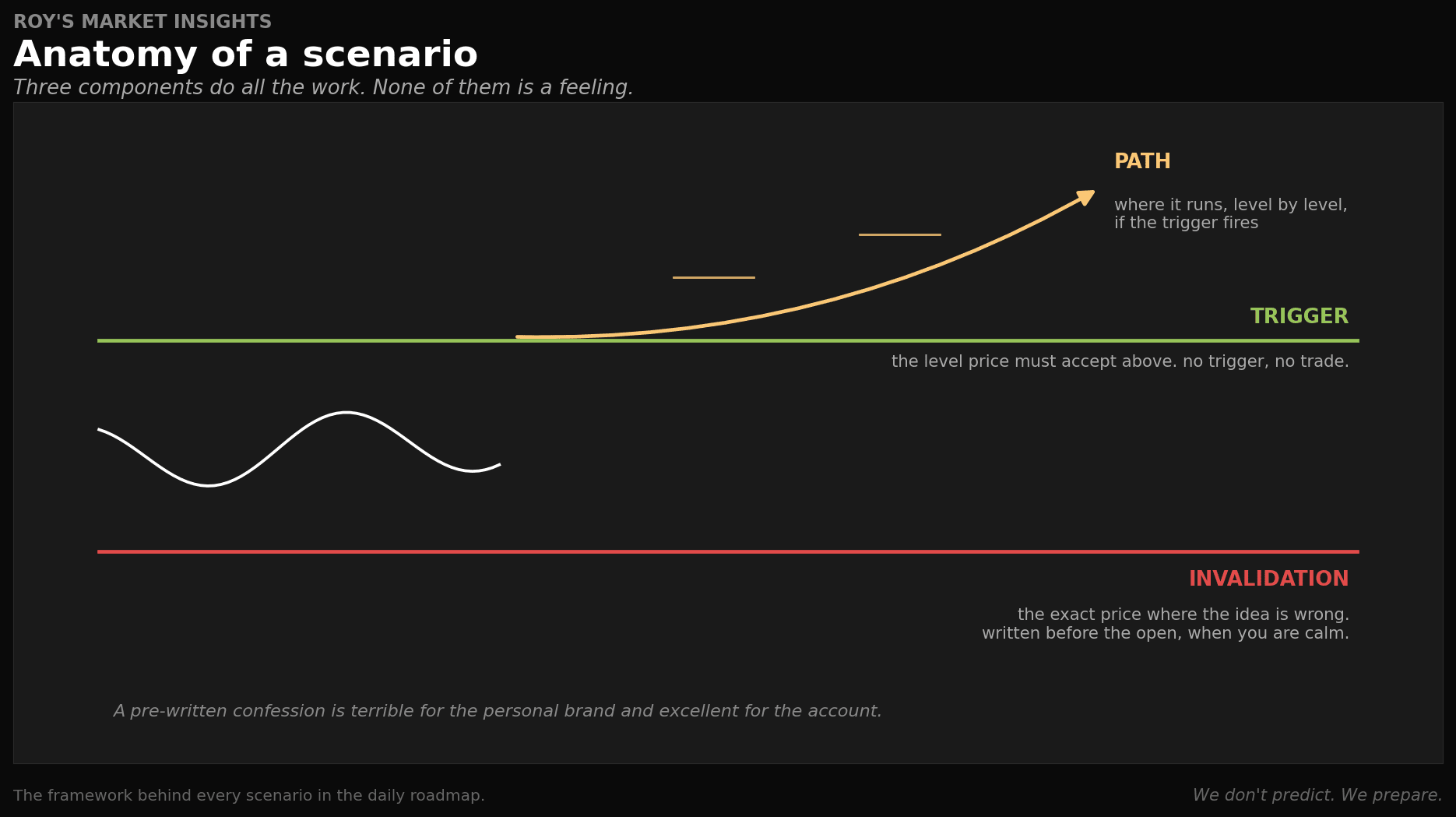
Every morning before the open, I map three scenarios for SPY, QQQ, and Gold. Not one prediction. Three paths. And each path comes with three components that do all the actual work:
The trigger. What price has to do to activate the scenario. Not what I feel, not what the vibes suggest. A specific level, held or broken, with acceptance. Until the trigger fires, the scenario is just a hypothesis minding its own business.
The path. Where price is likely headed if the trigger fires, level by level, based on where the actual volume sits. Markets move between shelves of prior business the way hikers move between campsites. The path is the terrain, not a promise.
The invalidation. The most important one, and the one the prediction industry never gives you. The exact price where the scenario is wrong. Written down before the open, when I am calm, so I do not have to invent it at 10:15 AM EST when I am not.
That last one deserves a moment. An invalidation level is a pre-written confession. It says: here is precisely where my read fails, and I am telling you in advance. Notice how rarely you see that on television. There is a reason. Confessions are terrible for the personal brand and excellent for the trading account.
A worked example, from last Wednesday
Theory is cheap, so here is a real one, recent enough that you can check every detail against a chart.
Last Wednesday, July 8, was objectively a terrible morning to own stocks. The ceasefire in the Gulf had just been declared over. Oil had spiked more than 5 percent. The premarket had QQQ opening below 705, which happened to be the floor of its entire July range, the shelf that had caught every dip for weeks.
The prediction business had one job that morning: pick a direction. Down felt obvious. War, oil, breakdown. Sell.
The preparation business had a different job: map the fork. The morning’s roadmap said, in plain terms, that opening below the range floor forces an immediate verdict, and both outcomes were tradeable. A reclaim of 705 would be a failed breakdown, one of the strongest long setups that exists, because every seller who pressed the lows would be trapped underneath. A rejection of 705 would open an air pocket toward 690. Two scenarios, two triggers, one level doing all the deciding. The map’s exact phrasing was that the one thing this open could not be is ambiguous.
What happened next was the fun part. QQQ flushed to 700.91, swept the lows, turned around, reclaimed the floor, and closed green. On a day the Dow lost 576 points. On a day the United States struck 90 targets in Iran. The growth index finished positive because the trapped sellers became the fuel, exactly the mechanics the failed-breakdown scenario described.
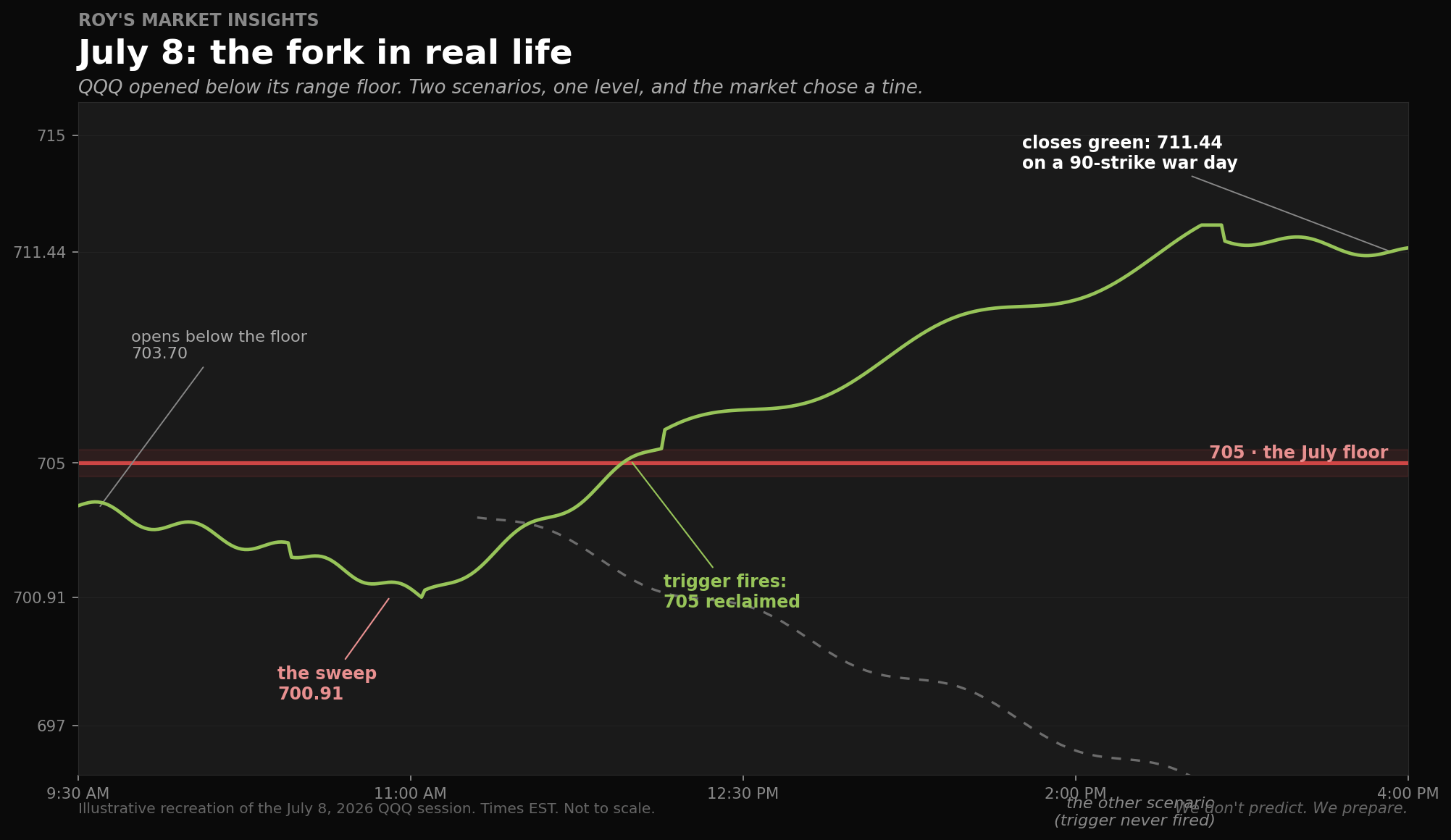
Now, the honest part, because this is where I am supposed to tell you I knew it would happen. I did not know. That is the whole point. If price had rejected 705 instead, the map had a path for that too, and the invalidation on the long idea would have kept anyone following it out of trouble. I did not predict the reversal. I prepared for the fork, and the market chose a tine.
The difference sounds small. Over a hundred trading days, it is everything.
Why your brain hates this
Preparation has a marketing problem, and the problem is your amygdala.
Humans are prediction machines. We evolved to commit to a story fast, because the ancestors who stood around weighing three scenarios about the rustling bush got eaten by the scenario with teeth. Certainty feels like safety. Ambiguity feels like weakness.
The market exploits this ruthlessly. When you predict, you marry the outcome. Every tick against you becomes a personal insult, and you start negotiating with the chart the way people negotiate with parking meters. Just five more minutes. It will come back. It knows I am here.
When you prepare, the relationship changes. A trade that hits its invalidation is not a betrayal, it is a scenario resolving. You wrote the exit before you entered. Nothing about being wrong is surprising, because being wrong was one of the three maps in your hand the whole time. You take the loss the way you take a toll booth. Annoying, priced in, and the road keeps going.
I will not pretend I learned this from a book, although the books help. I learned it the way most traders learn it, by donating money to the market during the years I thought I was in the prediction business. The tuition was not tax-deductible.
What this looks like every morning
So here is the actual product of this philosophy, published before the open every trading day.
A macro read that is verified, not vibes. Every number in the roadmap is sourced and checked, because a map drawn on bad terrain data gets people lost. Then, for SPY, QQQ, and Gold: the higher timeframe structure, the intermediate levels where the volume actually sits, and three scenarios each, with the trigger, the path, and the invalidation spelled out to the dollar. It closes with one decisive level per instrument, the single line in the sand that tells you which scenario is live.
Then the market opens and does whatever it wants, which is its right. Some days it picks the first scenario in the first half hour. Some days it picks the second and stays there until lunch out of what I can only assume is spite. The map does not care. The map’s job is to make sure that whichever door the crowd takes, you already knew where it leads and where it fails.
That is the whole business. No predictions, no mountains on posters, no pretending the rustling bush is definitely a rabbit.
The part where I tell you what this costs
The daily roadmap’s full structure, the intermediate levels, and all nine scenarios sit behind the paywall, because that is the part with the exact prices in it and exact prices are what pay for the coffee. The macro read and the higher timeframe structure stay free, every day, so you can judge the thinking before you spend a cent.
If the way this piece thinks matches the way you want to trade, the daily map is waiting for you tomorrow before the open.
We don’t predict. We prepare.
— Roy
Roy’s Market Insights | royreports.substack.com. Published for educational and informational purposes only. Not investment advice.
What I liked most is the difference between calling a direction and preparing for a fork.
A prediction makes you defend one outcome. A roadmap with triggers, paths, and invalidation lets the market choose first, then tells you what to do next.
The invalidation level is the part most people skip, but it may be the part that keeps the whole process honest.
The invalidation level is the part that translates outside trading entirely. Most financial content, fundamental or technical, tells you why a thesis is right and quietly skips the part where it says exactly what would prove it wrong. Writing that down before you’re emotionally attached to being right is the whole game.